Part Exchange House Explained (Is it Worth it in 2026?)
Updated: January 2026
Part exchange can make moving easier by letting a developer buy your current home as part payment for a new build. You gain speed and certainty, but usually accept a lower price than you would when selling on the open market. For some homeowners, that trade-off makes sense for others, it doesn’t.
Key Takeaways:
- Faster, chain-free move without listing your home.
- You typically accept below market value.
- Assuming all homes qualify or that the offer reflects full value.
What Does Part Exchange Mean When Buying a House?
Part exchange means a property developer buys your existing home and deducts its agreed value from the price of the new-build property you are purchasing, allowing you to move without selling on the open market.
Is Part Exchange Worth it in 2026?
Part exchange suits homeowners prioritising speed, certainty, and a chain-free move, especially when buying a new build. It is less suitable if maximising sale price matters, if your property is harder to resell, or if you are flexible on timing. The decision comes down to convenience versus value.
How Does Part Exchange Work on a House?
Part exchange is a simple process where the developer acts as your buyer, making your move quicker and less stressful. Here’s how it works from start to finish.
Step-by-Step Guide
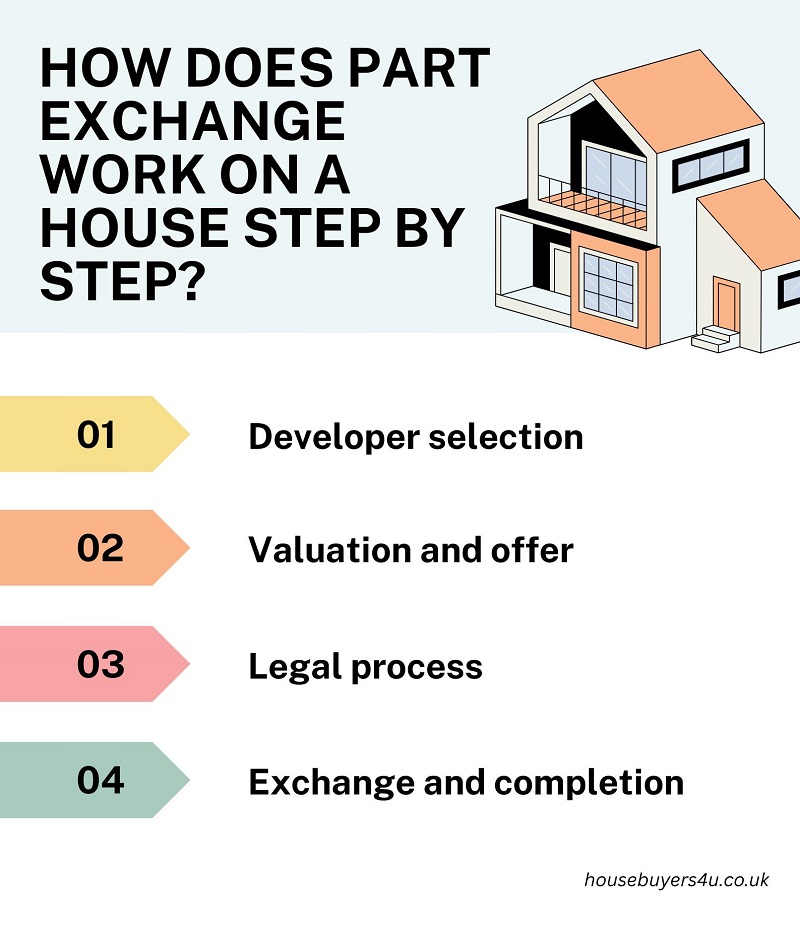
- Developer Selection: Find a developer offering part exchange on the property you want to buy.
- Valuation and Offer: The developer arranges independent valuations and makes you an offer, typically at a price below market value.
- Legal Process: If you accept, solicitors handle contracts and checks while you arrange your mortgage.
- Exchange and Completion Day: You pay a reservation fee, exchange contracts, and complete the sale, usually within weeks.
What Happens to Your Old House?
Once you complete the process, the developer will resell your old home on the open market. You stay in your current property until your new one is ready, so there’s no need for temporary moves or short-term rentals.
Related Read: How old is my house?
Can you Part-Exchange your House?
Most developers accept standard, easily resold homes in good condition, typically where the existing property value is around 65–75% of the new build price. Homes with short leases, unusual construction, or significant work required are often excluded. Eligibility varies by developer.
How Much do you usually get with Part Exchange? (Hb4u Data)
| What homeowners expect | What usually happens |
|---|---|
| Near full market value | Offers are usually discounted |
| Flexible negotiation | Pricing is largely fixed |
| All homes qualify | Many are declined |
Based on our internal enquiries and completion data, part-exchange offers typically range from 80% to 90% of open-market value, depending on condition, location, and resale demand.
Expert advice from our property expert Paul Gibbens:
"We see many homeowners assume part exchange is a guaranteed route, but developers are very selective. If a property isn’t easy to resell, it simply won’t be accepted. Checking eligibility early avoids wasted time and false expectations."
Part Exchange House: Pros and Cons
| Pros | Cons |
|---|---|
| Chain-free sale | Lower than market value |
| Faster completion | Limited negotiation |
| No estate agent fees | Strict eligibility rules |
| Predictable timelines | New build resale risk |
Part Exchange Return Rates in the UK
| Transaction Type | Typical Offer (% of Market Value) | Estimated Discount |
|---|---|---|
| New Build Developer Scheme | 80–90% | 10–20% |
| Independent PX Provider | 80–85% | 15–20% |
Source: Zoopla
This table highlights that homeowners opting for part exchange typically receive offers between 80% and 90% of their property's market value, resulting in an estimated discount of 10% to 20% of the property's value. These figures are consistent across both new-build developer schemes and independent part-exchange providers.
While part-exchange offers the advantages of a quicker sale and reduced hassle, it's essential to weigh these benefits against the potential financial trade-off. For those prioritising speed and convenience over maximising sale price, part exchange can be a viable option.
See How our Cash Offer Compares to Part Exchange