Can Estate Agents Lie About Offers? UK Rules, Proof & Red Flags

No. Estate agents cannot invent offers, exaggerate competing bids or deliberately misrepresent an offer to pressure a seller or buyer. If you are selling a property, your estate agent must also tell you about offers received, including offers made after you have already accepted one and before contracts are exchanged. The agent should give you enough information about the buyer's position to help you decide whether the offer is genuinely proceedable.
3 Key Takeaways:
-
Estate agents must pass offers to the seller and cannot invent or misrepresent competing offers.
-
Sellers should compare the buyer's position as well as the headline price.
-
Buyers generally cannot demand documentary proof of another person's offer, but agents must keep proper records and handle negotiations fairly.
-
- Can Estate Agents Lie About Offers?
- Do Estate Agents Have to Tell Sellers About Every Offer?
- Can Estate Agents Tell You How Much Someone Else Has Offered?
- What Should Sellers Ask Their Estate Agent When an Offer Comes In?
- What We See When Homeowners Need to Sell Soon After Buying
- Estate Agent Sale vs Direct Cash Sale
- Frequently Asked Questions
Can Estate Agents Lie About Offers?
No. An estate agent cannot lawfully invent a competing buyer, make up a higher offer or give misleading information about an offer in order to influence a property negotiation.
The Property Ombudsman's March 2026 Code of Practice states that agents must not misrepresent or invent the existence or details of another offer or the status of another buyer. Consumer protection law also prohibits misleading commercial practices that could cause someone to make a different transactional decision.
In simple terms, an agent can negotiate firmly on the seller's behalf. They cannot create a fake offer to manufacture urgency.
Do Estate Agents Have to Tell Sellers About Every Offer?
Yes, with a limited exception.
Estate agents are legally obliged to pass offers to the seller right up until contracts are exchanged.
This includes offers:
-
below the asking price
-
above the asking price
-
from cash buyers
-
from buyers needing a mortgage
-
received after another offer has already been accepted
A seller can, however, give written instructions that they do not want certain types of offers passed on.
For example, you could tell your agent not to contact you about offers below £300,000.
Outside an instruction like that, the agent should pass the offer on promptly.
What Information Should an Estate Agent Give You About an Offer?
The price is only part of the decision.
When an offer is being considered, the agent should take reasonable steps to establish the source and availability of the buyer's funds and pass relevant information to the seller.
That can include whether the buyer:
-
needs to sell another property
-
already has a buyer
-
requires a mortgage
-
claims to be a cash buyer
-
has proof of funds available
-
has conditions attached to the offer
For sellers, this information can be just as important as the amount offered.
The Highest Offer Is Not Always the Strongest Offer
| Buyer | Offer | Position |
|---|---|---|
| Buyer A | £310,000 | Has a property to sell and still needs a mortgage |
| Buyer B | £305,000 | Chain-free with mortgage agreed in principle |
Buyer A is offering £5,000 more.
But Buyer B may offer a simpler route to completion.
Rightmove reported in 2026 that 23% of property transactions initially fall through before later either returning to market or completing through another sale.
A seller should therefore compare:
-
offer amount
-
chain position
-
mortgage position
-
deposit
-
proposed timescale
-
conditions attached to the offer
Price matters, but so does the likelihood of reaching completion.
Do Estate Agents Have to Tell Buyers About Other Offers?
There is an important distinction here.
An estate agent's primary duty is to the seller.
However, The Property Ombudsman's 2026 Code says member agents should keep buyers who have recently made offers, and whose offers have not already been rejected, informed of the existence of other offers submitted to the seller.
That does not automatically mean the buyer is entitled to know the amount.
So an agent might legitimately say: Another offer has now been received.
Without saying: The other buyer has offered £315,000.
Can Estate Agents Tell You How Much Someone Else Has Offered?
Sometimes, but they need to handle this carefully.
Under The Property Ombudsman Code, if an agent intends to disclose the amount of competing offers, they should first obtain the seller's agreement.
If an offer amount is disclosed to one buyer, the agent should disclose offers consistently to all buyers currently involved in negotiations.
For sellers, the simplest approach is to agree with your estate agent at the start how you want competing offers handled.
Can You Ask an Estate Agent for Proof of an Offer?
If You Are the Seller
Yes, you can reasonably ask your agent to confirm the offer in writing.
The agent should be able to tell you:
-
the amount
-
when it was received
-
any conditions attached
-
the buyer's chain position
-
how they intend to fund the purchase
The Property Ombudsman Code requires member agents to keep a written or electronic record of offers received, including the date, time and seller's response.
This gives sellers a clear audit trail of the negotiation.
If You Are Another Buyer
You generally cannot demand to see another buyer's email, mortgage agreement or proof of funds.
Those documents can contain personal or financial information.
You can ask:
-
whether another offer genuinely exists
-
whether it has been submitted to the seller
-
whether the seller has accepted it
-
whether the property remains available
But there is not generally a right to inspect another buyer's private offer documents.
What Is a Phantom Offer?
A "phantom offer" is the informal term for a competing offer that does not actually exist.
For example:
"We've just had £320,000 from another buyer, so you'll need to increase immediately."
If no such offer exists, that would be a serious problem.
The difficulty is that a buyer usually cannot independently verify every competing offer.
That is why sellers should insist on good record keeping and buyers should avoid increasing their bid purely because they feel pressured.
What Should Sellers Ask Their Estate Agent When an Offer Comes In?
Before deciding whether to sell, our team would check these five figures first:
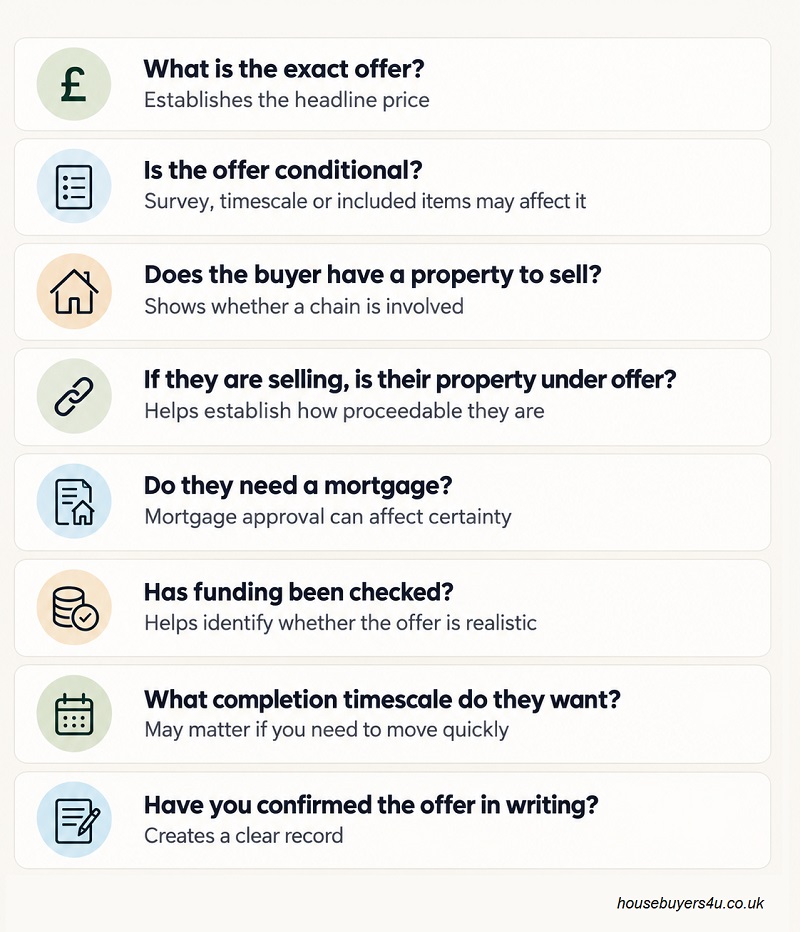
| Question | Why it matters |
|---|---|
| What is the exact offer? | Establishes the headline price |
| Is the offer conditional? | Survey, timescale or included items may affect it |
| Does the buyer have a property to sell? | Shows whether a chain is involved |
| If they are selling, is their property under offer? | Helps establish how proceedable they are |
| Do they need a mortgage? | Mortgage approval can affect certainty |
| Has funding been checked? | Helps identify whether the offer is realistic |
| What completion timescale do they want? | May matter if you need to move quickly |
| Have you confirmed the offer in writing? | Creates a clear record |
Expert insight from our property expert, Paul Gibbens:
"When sellers receive several offers, the highest one naturally gets the most attention. But I would always ask how proceedable that buyer actually is. A slightly lower offer from somebody with their finances ready and no complicated chain can sometimes give the seller a much clearer route to completion."
What We See When Homeowners Need to Sell Soon After Buying
From the sellers our team speaks to, the reason for moving quickly often matters less than the numbers surrounding the sale.
The main issues we look at are:
| Situation | What matters most |
|---|---|
| Bought within the last six months | Whether the buyer's lender will accept the short ownership period |
| Recently started a fixed mortgage | Size of the ERC and whether the mortgage can be ported |
| Property value has fallen | Whether there is enough equity to repay the lender |
| Unexpected property problems | Cost of repairs compared with selling as-is |
| Urgent relocation | Whether waiting six months is realistic |
| Sale needed quickly | Whether the seller needs a mortgage-funded buyer or can consider cash |
Estate Agent Sale vs Direct Cash Sale
| Estate agent sale | Direct cash sale |
|---|---|
| Usually best route for pursuing full open-market value | Offer will normally be below full market value |
| May involve competing offers | One direct buyer |
| Buyer may depend on a mortgage | Genuine cash buyer does not require mortgage finance |
| May involve an onward chain | Can be chain-free |
| Offer can change or fall through before exchange | Fewer third parties involved |
Neither route is automatically right for every seller.
If achieving the highest possible price is your priority and you have time, an estate agent sale will usually make more sense. If certainty and speed matter more, a direct cash offer can give you another figure to compare.
Housebuyers4u buys properties directly using its own funds, so sellers do not have to rely on a mortgage-funded buyer or onward chain.
Find out how much we can Offer for your House