How Soon Can You Sell a House After Buying It in the UK?

You can sell a house as soon as you own it. There is no general UK law requiring you to wait six months, a year or any other fixed period before selling again. The main complication is practical rather than legal. If you sell within the first six months, some mortgage lenders may be unwilling to lend to your buyer or may require extra checks. You may also face early repayment charges on your own mortgage, selling costs or negative equity if the property has not increased enough in value.
3 Key Takeaways:
- There is no general legal minimum period before you can resell a house.
- Selling within six months can reduce your pool of mortgage-funded buyers.
- Check your mortgage balance, early repayment charges and likely sale proceeds before listing.
-
- How Soon After Buying a House Can You Sell It?
- What Is the Six-Month Rule When Selling a House?
- Why Do Mortgage Lenders Care About Quick Resales?
- The Five Numbers to Check Before Selling Early
- Selling Quickly After Buying: Your Main Options
- Can Housebuyers4u Buy a Property You Recently Purchased?
- Frequently Asked Questions
How Soon After Buying a House Can You Sell It?
Legally, you can put your property back on the market as soon as your purchase has completed.
You do not have to own it for six months before selling.
However, selling quickly can become more complicated when:
- Your buyer needs a mortgage
- Your own mortgage has an early repayment charge
- Your Land Registry registration is still being processed
- The property is worth less than you paid
- Your sale proceeds will not cover your mortgage and selling costs
So the question is not simply "Can I sell?" It is whether selling now makes financial and practical sense.
What Is the Six-Month Rule When Selling a House?
The commonly discussed six-month rule is not a law preventing you from selling.
The UK Finance Mortgage Lenders' Handbook tells conveyancers acting for mortgage lenders to report when the seller or registered proprietor has been registered as owner for less than six months. Individual lenders can then apply their own requirements.
That means a property bought three months ago can legally be sold, but the buyer's lender may:
- Ask why it is being resold so quickly
- Request additional valuation evidence
- Carry out extra fraud or ownership checks
- Impose its own minimum ownership requirement
- Decline to lend on the transaction
Some lenders are stricter than others.
| Question | Answer |
|---|---|
| Can you legally sell within six months? | Yes |
| Is there a UK law forcing you to wait six months? | No |
| Could your buyer's mortgage lender object? | Yes |
| Can lender policies vary? | Yes |
| Is a cash buyer affected by mortgage lending criteria? | No |
Why Do Mortgage Lenders Care About Quick Resales?
A property being bought and sold again very quickly can raise questions about:
- Sudden changes in value
- Back-to-back transactions
- Property flipping
- Fraud
- Unusual ownership arrangements
This does not mean there is anything wrong with selling quickly.
There are plenty of genuine reasons to move shortly after buying, including:
- Job relocation
- Relationship changes
- Financial pressure
- Discovering the property does not suit your needs
- Needing to move closer to family
- Unexpected repair costs
- Buying another property
If you are selling within six months, be prepared for your conveyancer or estate agent to explain the circumstances clearly.
What If Your Land Registry Registration Is Still Pending?
This can happen if you try to resell soon after completing your purchase.
HM Land Registry says your legal ownership rights are protected from the date it receives a valid registration application, rather than only once the register itself has been updated.
However, a pending registration can still hold up a later sale or mortgage.
If your resale is being delayed because your ownership has not yet been registered, HM Land Registry allows an application to be expedited where the delay is putting a property transaction at risk.
Speak to your conveyancer rather than waiting until you have a buyer ready to exchange.
Will You Pay an Early Repayment Charge?
Possibly.
If you bought the property using a fixed-rate, discounted or otherwise restricted mortgage deal, selling shortly afterwards may mean repaying the mortgage during its early repayment charge period.
An ERC is normally calculated as a percentage of the outstanding mortgage balance and often reduces as you move closer to the end of the mortgage deal.
Before listing the property, ask your lender for:
- Your current mortgage balance
- The early repayment charge
- Any mortgage exit fee
- Whether your mortgage can be ported to another property
Porting may allow you to move your existing mortgage product to a new home, subject to the lender approving the new property and your circumstances.
Could You Lose Money Selling Soon After Buying?
Yes, even if the property's market value has not fallen.
Buying and selling both involve costs.
If you bought for £300,000 and sold six months later for £300,000, you would not necessarily break even because you may already have paid:
- Stamp Duty Land Tax or equivalent property tax
- Solicitor fees when buying
- Mortgage arrangement or valuation fees
- Survey costs
- Moving expenses
You could then face:
- Estate agent fees
- Conveyancing costs
- An early repayment charge
- Another set of moving costs
This is why the sale price alone does not tell you whether an early resale makes financial sense.
The Five Numbers to Check Before Selling Early
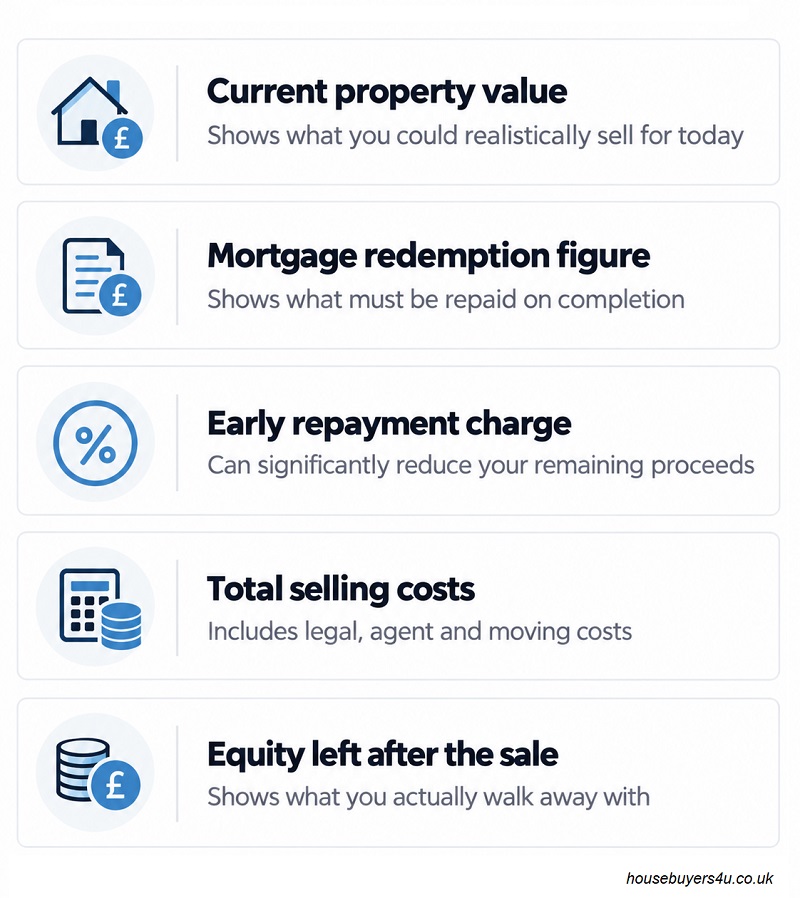
Before deciding whether to sell, our team would check these five figures first:
| What to check | Why it matters |
|---|---|
| Current property value | Shows what you could realistically sell for today |
| Mortgage redemption figure | Shows what must be repaid on completion |
| Early repayment charge | Can significantly reduce your remaining proceeds |
| Total selling costs | Includes legal, agent and moving costs |
| Equity left after the sale | Shows what you actually walk away with |
What We See When Homeowners Need to Sell Soon After Buying
From the sellers our team speaks to, the reason for moving quickly often matters less than the numbers surrounding the sale.
The main issues we look at are:
| Situation | What matters most |
|---|---|
| Bought within the last six months | Whether the buyer's lender will accept the short ownership period |
| Recently started a fixed mortgage | Size of the ERC and whether the mortgage can be ported |
| Property value has fallen | Whether there is enough equity to repay the lender |
| Unexpected property problems | Cost of repairs compared with selling as-is |
| Urgent relocation | Whether waiting six months is realistic |
| Sale needed quickly | Whether the seller needs a mortgage-funded buyer or can consider cash |
Expert insight from our property expert Paul Gibbens:
“When someone needs to sell shortly after buying, I would check the mortgage before anything else. A homeowner can legally sell, but an early repayment charge, a small amount of equity or the buyer's lender refusing a short-ownership property can completely change the options. Work out what you would actually walk away with before deciding whether to sell now or wait.”
Is It Better to Wait Six Months Before Selling?
Sometimes, but not automatically.
Waiting can make sense if:
- It gives you access to a wider pool of mortgage-funded buyers
- Your early repayment charge will reduce
- You expect to build more equity
- You have no urgent reason to move
Selling earlier may make more sense if:
- You need to relocate
- The mortgage is becoming unaffordable
- Personal circumstances have changed
- The property requires work you do not want to undertake
- The financial cost of waiting is greater than the cost of selling
There is no universal best time.
Compare the cost of selling now with the cost of owning the property for another six or twelve months.
Can a Cash Buyer Buy Your House Within Six Months?
The six-month lender issue mainly matters because a conventional buyer may depend on a mortgage lender approving the property.
A genuine cash buyer does not require mortgage finance to complete the purchase, so that particular lending restriction does not apply.
This can make a cash sale an option where you genuinely need to sell before the six-month point.
Related Read: How the quick house sale process works
Selling Quickly After Buying: Your Main Options
| Route | Main advantage | Main drawback |
|---|---|---|
| Wait until after six months | Wider mortgage-buyer pool | You continue paying mortgage and ownership costs |
| Sell through an estate agent immediately | Opportunity to achieve open-market value | Some buyers may face lender restrictions |
| Sell to a cash buyer | No buyer mortgage restriction | Offer will normally be below full market value |
If achieving the highest possible price matters most and you can afford to wait, the open market will usually be the first route to consider.
If circumstances mean you cannot wait, compare the cost of holding the property with the amount you would receive from a faster sale.
Can Housebuyers4u Buy a Property You Recently Purchased?
Yes, subject to the usual legal checks.
Housebuyers4u buys directly using cash, so our purchase does not depend on a mortgage lender approving the short period of ownership.
If you need to sell because of relocation, financial pressure, a relationship change, unexpected repairs or another change in circumstances, we can give you a no-obligation cash offer to compare with your other options.
A direct cash offer will normally be below full open-market value, but it can remove the buyer's mortgage and onward-chain issues that can make an early resale harder.
Find out how much we can Offer for your House