Should I Sell My Rental Property or Keep Renting It Out?
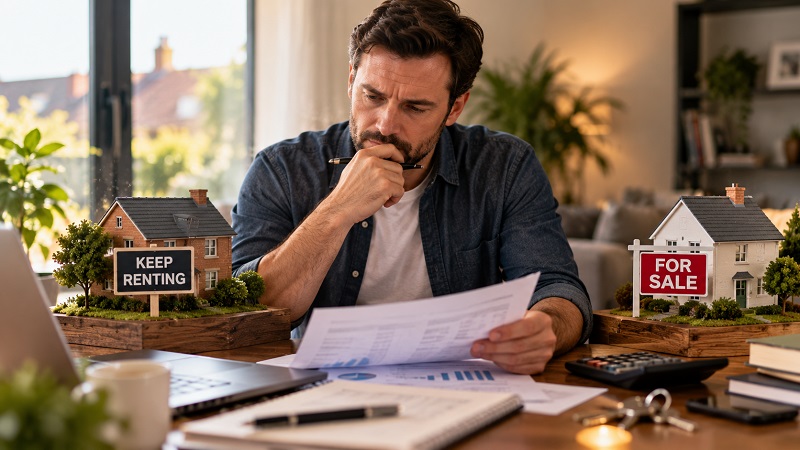
If your rental property still produces reliable profit after mortgage costs, repairs, management, void periods and tax, keeping it may make sense. If the property is barely breaking even, needs major work, has become difficult to manage or you could use the equity more effectively elsewhere, selling may be the stronger option.
3 Key Takeaways:
-
Keep renting if the property produces worthwhile net income and still fits your long-term plans.
-
Selling may make more sense if mortgage costs, repairs, tax or management are eroding the return.
-
If tenants are already living there, you can potentially sell with them in situ or seek vacant possession using the correct legal process.
Should I Sell My Rental Property or Keep It?
Start with the numbers.
A property collecting £1,500 a month is not necessarily a good investment if most of that income disappears through mortgage interest, repairs, insurance, management fees, compliance costs and tax.
Equally, selling a profitable property simply because costs have increased could mean giving up reliable rental income and future capital growth.
We would compare these six figures first:
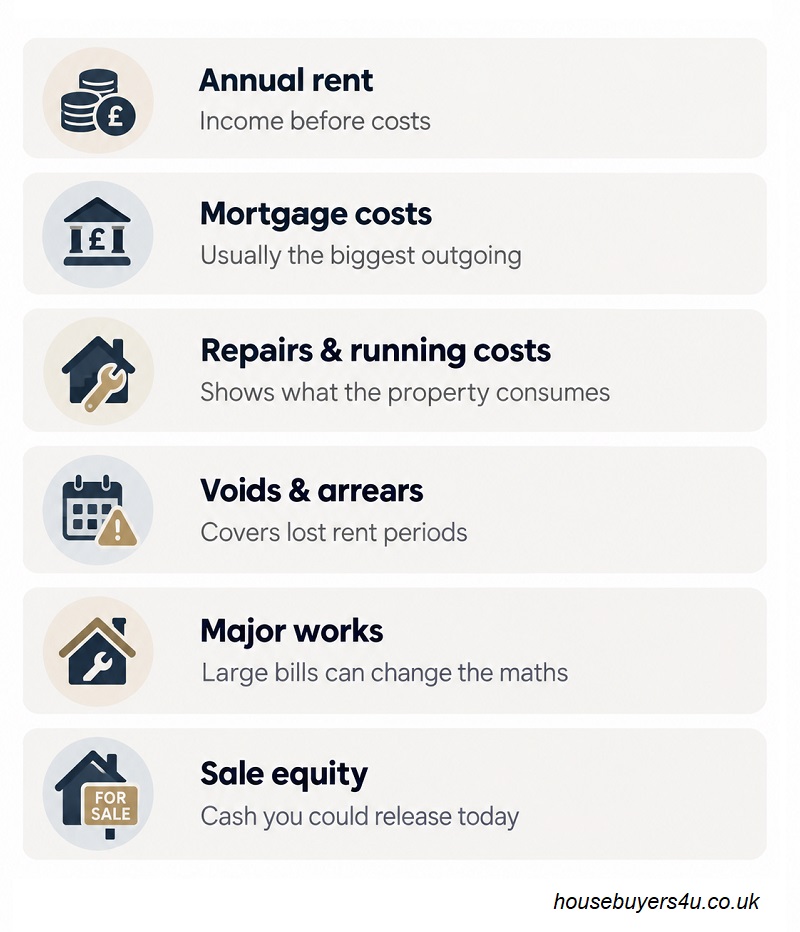
| What to check | Why it matters |
|---|---|
| Annual rental income | Shows what the property generates before costs |
| Mortgage and finance costs | Often the largest outgoing |
| Repairs and running costs | Shows how much income the property actually consumes |
| Typical void or arrears cost | Accounts for periods when rent may not be collected |
| Major work coming up | Roofs, boilers and other large repairs can change the calculation quickly |
| Equity available if you sell | Shows what capital you could release today |
The decision becomes much clearer once you compare annual net return against equity tied up in the property.
When Does Keeping a Rental Property Make Sense?
Yes, with a limited exception.
Estate agents are legally obliged to pass offers to the seller right up until contracts are exchanged.
This includes offers:
-
below the asking price
-
above the asking price
-
from cash buyers
-
from buyers needing a mortgage
-
received after another offer has already been accepted
A seller can, however, give written instructions that they do not want certain types of offers passed on.
For example, you could tell your agent not to contact you about offers below £300,000.
Outside an instruction like that, the agent should pass the offer on promptly.
When Might Selling Your Rental Property Make More Sense?
Selling becomes more worth considering when several of these happen together:
| Situation | Why selling may become more attractive |
|---|---|
| Mortgage costs have risen sharply | Reduces monthly cash flow |
| Rental profit is very small | A large amount of equity may be producing little return |
| Major repairs are approaching | More capital will need to be invested |
| Regular voids or arrears | Makes income less predictable |
| Managing tenants is taking too much time | The investment may no longer suit your circumstances |
| You want to retire or reduce your portfolio | Selling releases capital and removes management responsibility |
| Property values have risen substantially | You may be able to realise accumulated equity |
| You need money elsewhere | Selling converts property equity into accessible capital |
Official landlord research shows this is already a real decision for many owners. Among landlords planning to reduce their portfolio, 66% cited recent tax or legislative changes, 44% forthcoming legislative changes and 40% investment viability factors such as rising interest rates.
That does not mean those landlords were necessarily right to sell. It shows why the decision needs to be based on the individual property's numbers rather than the assumption that property should always be held indefinitely.
Remember the Tax on Rental Income
For personally owned residential property, mortgage finance costs are not generally deducted from rental income in the same way as ordinary property expenses.
Instead, individual landlords normally receive a basic-rate tax reduction equal to 20% of qualifying finance costs, subject to HMRC's rules.
This can make highly mortgaged rental properties less attractive for some higher-rate taxpayers.
Do not decide to sell purely because of one tax rule, though. Your actual position depends on your income, ownership structure, borrowing and other circumstances.
What Tax Could You Pay if You Sell?
If the rental property has increased in value, Capital Gains Tax may apply.
For individuals in the 2026/27 tax year, CGT rates are 18% and 24%, depending on your taxable income and the amount of the gain. The annual exempt amount is currently £3,000.
You may normally deduct certain allowable buying, selling and improvement costs when calculating the gain.
Where CGT is due on a UK residential property sale, according to HMRC it generally needs to be reported and paid within 60 days of completion.
Before selling, ask an accountant or tax adviser to calculate what you would actually keep after:
-
Capital Gains Tax
-
estate agent fees
-
legal costs
-
any early repayment charge
The headline sale price is not the amount that lands in your bank account.
What We See When Landlords Are Deciding Whether to Sell
From the landlords our team speaks to, there is rarely one single reason for selling.
More often, several smaller pressures build up at once.
A landlord may still be collecting rent every month, but their mortgage has become more expensive, the property needs a new roof, the tenant is leaving and they are questioning whether they want to put another £10,000 or £15,000 into the property.
That is usually the point where we would compare two figures:
What does the property realistically produce if you keep it for another three to five years?
Against:
What cash could you release by selling it now?
We would not sell a profitable, manageable rental simply because being a landlord has become more expensive.
But we also would not keep a property purely because "house prices always go up". The investment still needs to work for you today.
Expert insight from our property expert, Paul Gibbens:
"I would look past the monthly rent and work out what the property genuinely leaves you with at the end of the year. If the return is still strong and you are happy being a landlord, there may be no reason to sell. But if repairs, finance costs and management are eating into the return while a large amount of equity is tied up, that is when selling deserves a serious look."
Can You Sell a Rental Property With Tenants Still Living There?
Yes.
Selling the property does not automatically end the tenancy.
If another landlord buys the property with the tenancy continuing, they become the new landlord and must take over the relevant landlord responsibilities. Citizens Advice confirms that when a landlord changes, the new landlord must provide the tenant with their name and address within the required period.
A tenanted sale can make sense where:
-
the tenant pays reliably
-
the rent is commercially attractive
-
the tenancy paperwork is in order
-
the buyer is specifically looking for an investment property
For an investor, an established tenant can actually be useful because rental income starts immediately.
Selling Your Rental Property With Housebuyers4u
If you decide to sell, you do not necessarily need to wait until the property is empty.
Housebuyers4u can buy rental properties with tenants in situ as well as vacant properties. This can be useful where you want to sell without waiting through a lengthy vacant-possession process or putting the tenant through unnecessary disruption.
We buy directly with our own funds, so the sale does not depend on a buyer obtaining a mortgage or joining an onward chain.
A direct cash offer will normally be below the full price you might achieve through a successful open-market sale, so compare both routes before deciding.
Find out how much we can Offer for your House