Can I Sell My House to My Limited Company?

Yes, you can sell a property you own personally to your own limited company. However, it is treated as a genuine property sale, not simply a change of name on the deeds. This means Capital Gains Tax, Stamp Duty Land Tax, mortgage charges and legal fees may apply.
3 Key Takeaways:
- You can sell your property to your limited company, but it counts as a real sale.
- CGT, SDLT, mortgage and legal costs can make the move expensive upfront.
- Company ownership can suit some landlords, but tax savings are not guaranteed.
Can You Sell Your House to Your Own Limited Company?
Yes. A limited company is legally separate from you, even if you are its only director and shareholder. This means your company can purchase a property that you currently own personally.
For tax purposes, you and a company you control are normally treated as connected parties. HMRC can therefore use the property’s market value when calculating tax, even if you transfer it to the company for less.
In practical terms, you normally need to:
- Establish the property’s current market value
- Arrange suitable company finance or cash
- Instruct a conveyancer
- Deal with your existing mortgage
- Calculate the tax due
- Complete the sale and register the company as the new owner
This guide mainly applies to landlords transferring investment property. If this is your main home and you intend to continue living there after the company buys it, the tax, mortgage and company implications can be different and specialist advice is important.
How Do You Sell a Property to Your Limited Company?
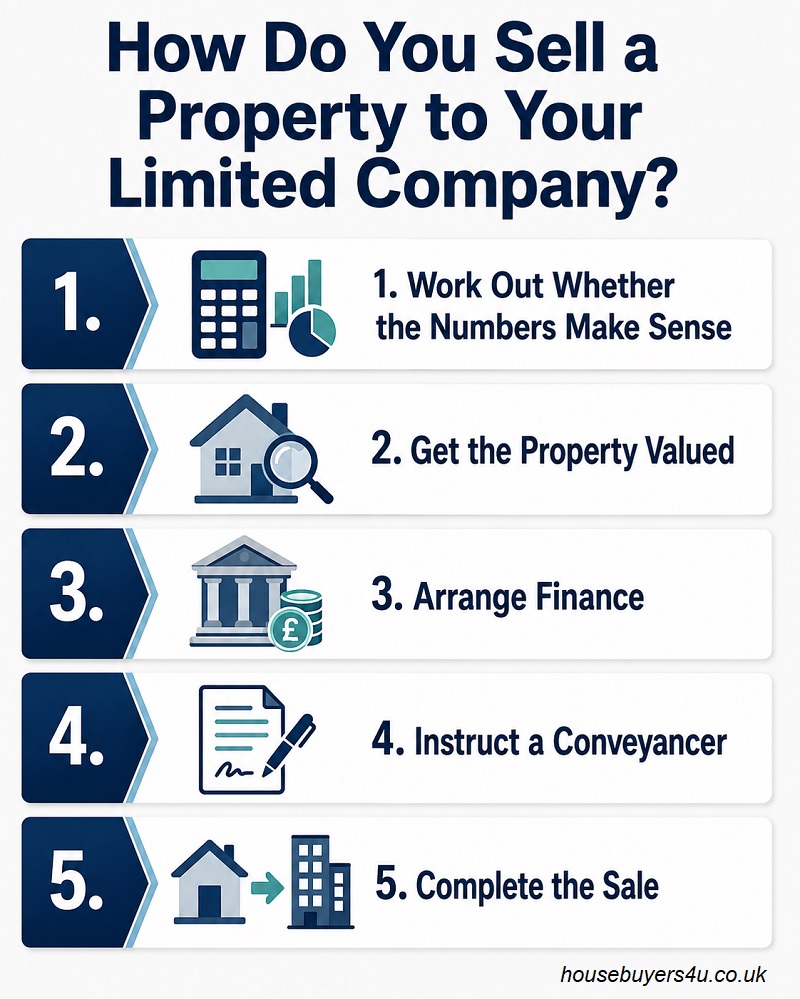
1. Work Out Whether the Numbers Make Sense
Before transferring anything, calculate the likely CGT, SDLT, mortgage charges, legal costs and ongoing company expenses.
An accountant or tax adviser can then compare those costs with the expected long-term benefit of company ownership.
2. Get the Property Valued
Do not simply choose a low sale price to reduce the tax bill.
Transactions between connected people and companies can be assessed using market value for both CGT and SDLT purposes. An independent valuation gives you evidence of what the property was reasonably worth at the time of sale.
3. Arrange Finance
If the company does not have enough cash to buy the property, it will normally need suitable limited-company property finance.
Your existing personal mortgage cannot usually just continue unchanged because ownership of the property is moving to a different legal entity. Check whether redeeming the mortgage will trigger early repayment charges.
4. Instruct a Conveyancer
The company is buying the property from you, so normal conveyancing is still required.
Your conveyancer will deal with the title, mortgage redemption, contracts, completion and registration of the company as the new owner.
5. Complete the Sale
Once the finance, tax position and legal work are ready, ownership passes from you personally to the company.
Example: What Could Moving a £300,000 Property Cost?
Consider a landlord who:
- Bought a rental property for £180,000
- Now it is valued at £300,000
- Is a higher-rate taxpayer
- Wants their own limited company to buy it
Ignoring allowable costs, reliefs and the annual CGT exemption for simplicity, the starting gain would be:
£300,000 current value - £180,000 purchase price = £120,000 gain.
At a 24% CGT rate, that could mean up to £28,800 of CGT before relevant deductions or reliefs.
Using the current higher SDLT rates for a £300,000 company purchase in England:
GOV.UK gives the same £20,000 SDLT calculation for a £300,000 purchase subject to the higher residential rates, based on the rates applying from 1 April 2025.
GOV.UK higher Stamp Duty Land Tax rates
| Portion | Rate | SDLT |
|---|---|---|
| First £125,000 | 5% | £6,250 |
| £125,001 to £250,000 | 7% | £8,750 |
| Remaining £50,000 | 10% | £5,000 |
| Total | £20,000 |
That creates a potential £48,800 in CGT and SDLT costs before conveyancing, valuation fees, mortgage charges, or any early repayment fee.
This does not mean every £300,000 incorporation costs £48,800. Reliefs, deductible costs and individual circumstances can significantly change the result. It shows why the upfront cost needs to be calculated before assuming company ownership will save money.
Pros and Cons of Selling Your Property to a Limited Company
| Potential advantages | Potential disadvantages |
|---|---|
| Different treatment of qualifying mortgage finance costs | CGT may arise when the property is sold to the company |
| Profits can be retained for future investment | The company may have a substantial SDLT bill |
| Can suit landlords building a long-term portfolio | Limited-company mortgage rates and fees may be higher |
| Property investments sit within a separate legal entity | Company accounts and administration create ongoing costs |
| Profits can be reinvested without first withdrawing them personally | Taking money out personally can create further tax |
What Our Team Sees From Landlords Considering Incorporation
At Housebuyers4u, we speak to landlords at different stages of this decision. Some want to keep investing and are looking at whether a company structure makes their portfolio more efficient. Others start calculating the transfer taxes, mortgage costs and future repair bills and decide they would rather sell the property altogether.
The issues we commonly see influencing that decision include:
| Issue | Why it changes the decision | Illustrative share |
|---|---|---|
| Large unrealised property gain | CGT can make transferring the property expensive | 18% |
| Existing mortgage deal | ERCs and new company finance can add substantial costs | 21% |
| Major repairs approaching | The landlord may not want to invest more capital into the property | 17% |
| Tenant or management problems | Running the property long term becomes less attractive | 16% |
| Retirement or portfolio reduction | A clean sale may be simpler than restructuring ownership | 19% |
| Need to release equity | Moving the property into a company may not achieve the owner's immediate goal | 9% |
Expert insight from our property expert Paul Gibbens:
“The question I would ask isn't simply whether a limited company pays less tax. You need to look at what moving the property will cost now, how long you plan to keep it and what you eventually want to do with the money. For some landlords, the numbers work. For others, once CGT, Stamp Duty, finance and future property costs are included, selling is the cleaner option.”
Selling Instead of Moving the Property Into a Company
If you are already considering leaving the rental market, calculate the full cost of incorporation before moving a property into a company you may later sell anyway.
Selling through an estate agent will usually be the better option if achieving the highest possible open-market price is your priority and you are comfortable waiting for a buyer.
A direct cash sale can be more suitable where speed and certainty matter more. Housebuyers4u buys both vacant and tenanted properties directly, without relying on a buyer's mortgage or onward chain. We can provide a no-obligation cash offer, cover standard legal fees and, where the legal process allows, complete in around 7 to 14 days.
Find out how much we can Offer for your House